
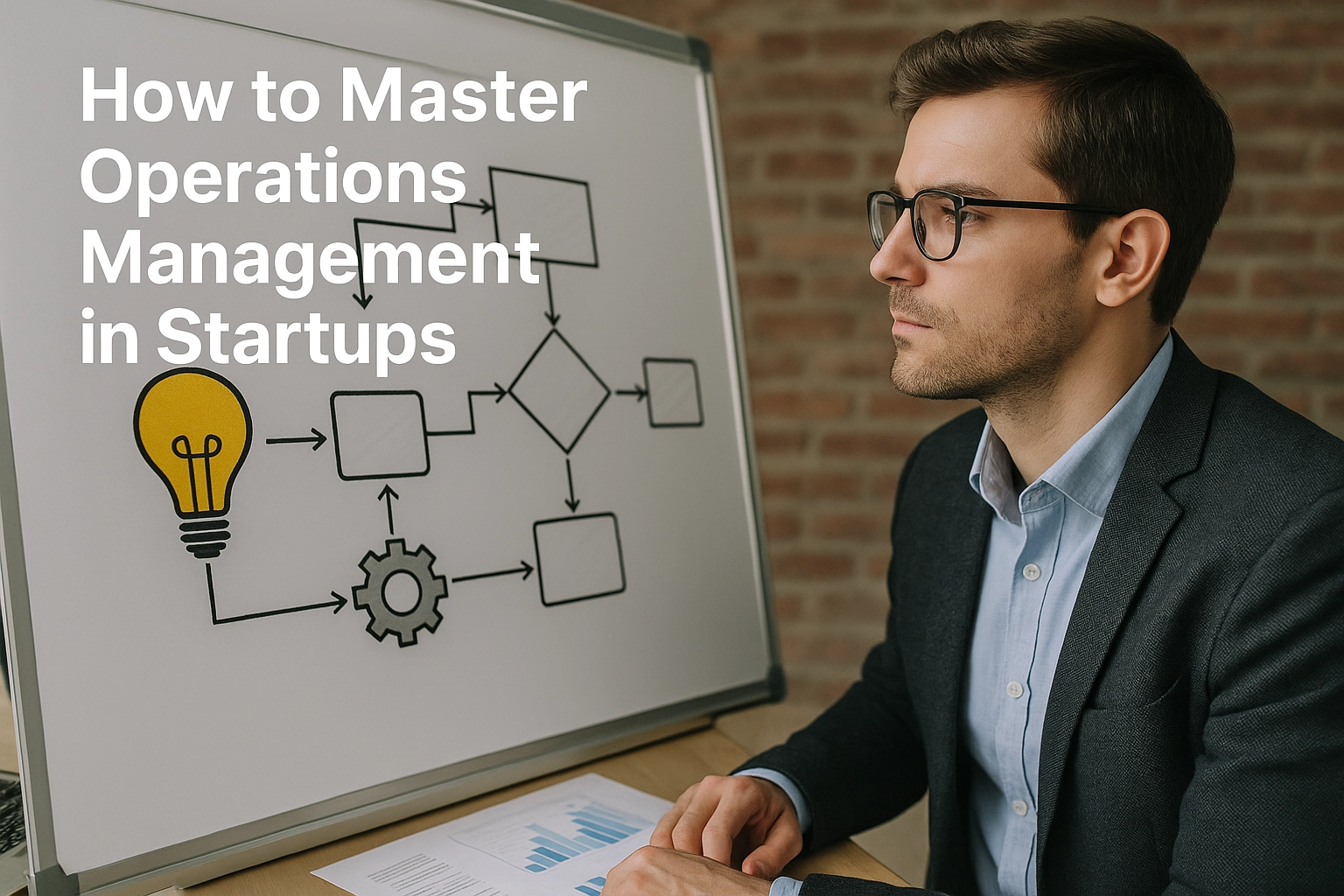
If your product is promising but the day-to-day feels chaotic, the problem is not ambition, it is operations. Startups grow on speed, then stumble on scale. The path to consistent delivery is a deliberate operating system, built step by step. Whether you are the founder wearing the ops hat or an operations manager startup teams rely on, this guide shows you how to turn goals into repeatable results without slowing down innovation.
You will learn how to map critical processes, design lightweight SOPs, and select the right metrics, cycle time, throughput, and quality, to drive decisions. We will cover capacity planning, prioritization, and WIP limits, plus how to build a clear operating cadence with reviews, standups, and retros that actually move work forward. You will get frameworks you can apply immediately, SIPOC, RACI, OKRs, and service blueprints, along with a pragmatic tooling stack for dashboards and automation. We will also tackle vendor management, incident response, and handoffs across product, engineering, and customer success. By the end, you will have a practical playbook to stabilize operations today and scale them as your startup grows.
Establishing a Solid Foundation: Initial Steps
Prerequisites and materials
- Clear founder intent and market hypothesis.
- A shared workspace for documentation and BPMN process maps.
- Analytics stack for product and support metrics.
- Shortlist of API‑first, white‑label SaaS tools to speed time to value.
- Define and communicate mission and vision effectively. Facilitate a 60‑minute workshop to draft one 10 to 20 word mission and one 10 to 20 word vision statement. Keep them concise, memorable, and directional, since these statements anchor your strategic plan and culture, providing durable guidance to teams at scale, see mission, vision and values as strategic foundations. Pressure test with five customers and five team members for clarity and recall, then refine using the principles in creating a clear brand vision and mission. Publish the final statements in onboarding, OKRs, and your website. Expected outcome: 90 percent of the team can recite both statements, and every quarterly objective maps to them, guided by how to set your startup’s mission and vision.
- Create a lean operational plan emphasizing scalability and user experience. Define a 30‑day MVP, core KPIs, and guardrails for reliability and cost. Use BPMN to document marketing, product, and customer service flows, including owners and SLAs, which improves handoffs and auditability. Adopt an API‑first tech stack with automation to streamline work, since AI, cloud, and automation consistently improve efficiency in operations. Implement AI‑powered ticket triage in support and instrument UX with task success rate, time on task, and an NPS target. Expected outcome: first cohort MVP shipped in under 6 weeks, 99.9 percent uptime target, and support first‑response under 2 minutes via automated routing.
- Identify key roles and responsibilities within the team. For an operations manager startup teams rely on, formalize a lightweight RACI for Founder or CEO, Product Manager, CTO, Marketing Lead, Sales Lead, Customer Success, and Finance. Assign process ownership per BPMN diagram and schedule a weekly ops review with a cross‑functional dashboard. Use white‑label SaaS where possible to retain full branding control and reduce build costs, reallocating savings to UX and support. Expected outcome: clear decision rights, fewer cross‑team blockers, and a predictable release, support, and revenue cadence as you scale.
Transition: With your foundation set, you can now design execution rhythms and metrics that compound every sprint.
Building an Efficient Operations Tech Stack
Prerequisites and materials
- A current process map for marketing, support, and product handoffs.
- A single source of truth for metrics and SLAs.
- Admin access to your core tools, API keys, and a sandbox environment.
- Clear success criteria for user experience, scalability, and cost.
1. Identify essential tools prioritizing user experience and scalability
Start with categories that reduce friction for both teams and customers. For project management and team communication, choose tools that are intuitive, have strong mobile apps, and offer robust APIs for future integrations. A Kanban-first project tool and a channel-based messaging platform are common choices for startups, and both are highlighted in this roundup of essential startup tools. Layer in marketing automation and lightweight finance software to keep pipeline and cash flow visible as you scale, options summarized here: Top tools every founder needs. Expected outcome: a lean, user-friendly stack that scales without replatforming, with documented owners and SLAs for each tool.
2. Integrate customer service platforms to enhance satisfaction
Consolidate email, chat, and in-app messaging into a single help desk with knowledge base, CSAT, and SLA tracking. Enable AI-powered ticketing and routing, which are recognized best practices in IT operations management, so repetitive issues are auto-triaged while complex ones reach specialists fast. Connect support to your CRM for a 360-degree view of accounts, then standardize macros, tags, and escalation paths using BPMN to document flows. Implement proactive messaging for onboarding, renewals, and outage notifications to reduce inbound volume and increase retention. Expected outcome: faster first-response and resolution times, higher CSAT, and transparent workload distribution.
3. Leverage automation and API-first tools for seamless operations
Adopt an API-first mindset so every tool can publish and consume events across your stack. Use an integration layer or iPaaS to synchronize customer, billing, and product data, then automate routine playbooks such as trial-to-paid conversions, failed payment recovery, and churn saves. AI, cloud, and automation are proven to streamline operations and improve efficiency, so prioritize capabilities like event-driven webhooks, service health alerts, and auto-remediation. Where appropriate, consider white-label modules to reduce build time while maintaining brand control and cutting development costs. Expected outcome: fewer manual handoffs, lower error rates, and faster cycle times that free your team to focus on growth.
Optimizing Processes: Tips for Efficiency
Prerequisites and materials: extend your BPMN maps with clear owners, SLAs, and handoffs, prepare a shared documentation space, and configure product, support, and marketing dashboards. Collect API keys for your core tools, SOP templates for intake and escalation, and a standardized agenda for weekly and monthly reviews. For an operations manager in a startup, the expected outcomes are faster cycle times, fewer rework loops, and earlier risk detection. Many teams see 15 to 25 percent efficiency gains when AI, cloud, and automation are applied to routine work, supported by industry surveys. White label platforms can also reduce development costs, allowing you to reinvest in process quality and customer experience.
Step 1: Develop structured workflows to increase productivity
Start by mapping your top five cross-functional processes, for example inbound lead to demo, trial to paid, incident to resolution, experiment to release, and invoice to cash. For each, define inputs, outputs, owners, SLAs, and success metrics, then document the flow using BPMN so the sequence, decisions, and escalations are unambiguous. Standardize intake with forms that capture required fields, which reduces ping pong delays and data defects. Automate repetitive steps with triggers, for example auto-assign tickets by skill, auto-provision trials, and tag issues by severity. For a deeper primer on agile, automation, and process reviews, see this guide on workflow optimization in technology startups.
Step 2: Empower teams through effective communication and shared tools
Publish a team communication contract that prefers asynchronous updates for status and blockers, and reserves live time for decisions. Centralize knowledge in a shared workspace so roadmaps, SOPs, and SLAs are searchable, which cuts meeting time and speeds onboarding. Adopt an API-first toolset so data flows smoothly between support, product, and finance, and enable AI-driven routing for tickets to reduce response times. Measure collaboration health with metrics like comment-to-closure ratio, cycle time variance, and documentation completeness. For practical tactics on centralization and focus time, explore these ways to optimize your startup’s workflow.
Step 3: Implement regular review meetings to track goals and performance
Run a 30 minute weekly operations review with a fixed agenda, last week’s commitments, KPI deltas, risks, and next actions. Hold a monthly deep dive on leading indicators, churn drivers, incident postmortems, and backlog aging, and reconcile to OKRs. Use a shared action log with owners and due dates so nothing is lost between meetings, and track hit rate on commitments. Apply design thinking techniques for tough problems, for example rapid framing, divergent idea rounds, and quick experiments, then convert winners into SOP updates. Close the loop by updating BPMN diagrams and automation rules after each review so improvements stick.
Harnessing Technology: Digital Transformation
For an operations manager startup leaders rely on, digital transformation converts well-documented processes into compounding leverage. Global surveys show AI, cloud, and automation streamline operations and improve efficiency, while sustainability and personalization define 2025 operating models. Study proven plays before you build. The Hitachi High-Tech case study highlights a fit-to-standard approach that cut customizations 94 percent and made updates 18 times faster. Retail and food service examples in Walmart and Starbucks digital transformation results show a 74 percent year-over-year ecommerce surge, route optimization trimming delivery costs about 20 percent per order, and mobile orders reaching 26 percent of U.S. sales.
Prerequisites and materials
- Current BPMN maps for support, marketing, and product changes.
- Access to analytics and SLA dashboards, plus a central data store.
- Admin rights and API keys for core tools, and an automation runner.
- Lightweight governance for data quality, security, and model approvals.
Step-by-step playbook
- Extract patterns from the success stories. Note how reducing customizations accelerates updates, and how omnichannel, AI supply chain, and mobile ordering drive revenue.
- Prioritize two high-ROI workflows. Target repetitive routing and decision bottlenecks; pilot AI-powered ticketing and triage to raise first-contact resolution and shrink handle time.
- Build an automation-first stack. Favor APIs, webhooks, and event streams; introduce RPA for clerical tasks, AIOps for incident detection, and predictive analytics for demand and backlog forecasting.
- Operationalize AI responsibly. Stand up ModelOps with versioning, monitoring, drift alerts, and human-in-the-loop reviews; document owners and SLAs in your BPMN.
- Scale with cost discipline. Use white-label SaaS where fit to reduce build costs and ship faster, then harden KPIs like cycle time, cost per ticket, MTTR, and deployment frequency.
Expected outcomes
- 20 to 30 percent reduction in manual handling costs from intelligent automation, with fewer errors.
- Faster incident resolution through AIOps and proactive monitoring, improving SLA attainment.
- Improved agility, reflected in shorter lead times and higher customer satisfaction.
Navigating Challenges: Troubleshooting Tips
Prerequisites and materials
- Current BPMN maps of your core workflows with owners and SLAs.
- Centralized monitoring, alerting, and a ticketing system with automation rules.
- Incident runbook templates, a communication tree, and role-based access.
- Product and support analytics, customer feedback channels, and survey tools.
- Budget line for load testing, backup and recovery, and selectively using white-label tooling to avoid unnecessary build costs.
- A shared dashboard for reliability metrics, change failure rate, and error budgets.
Step 1: Triage the most common operational risks
Start by inventorying failure modes across tech, people, and process, then score them by likelihood and business impact. Address tech debt directly, since research shows 70 percent of early IT startups wrestle with it and it can consume up to 40 percent of engineering time, a classic drag on throughput, as outlined in this guide on operational challenges in growing IT startups. Harden security basics with least privilege, secrets rotation, and periodic audits, which is critical when resources are tight, as noted in this overview on ensuring smooth operations in startups. Instrument proactive monitoring and AI-powered ticket routing to cut alert noise and shrink time to acknowledgment. Finally, document the updated flows in BPMN, assign owners, and create a visible backlog that reserves capacity for risk remediation every sprint.
Step 2: Adapt in real time using data and feedback
Define a small set of operational SLOs, for example uptime, latency p95, ticket first response, and change failure rate, and display them on a live scoreboard. Automate alerts tied to SLO thresholds, then enable rapid experiments, such as A/Bing deployment strategies or support triage rules, to validate improvements quickly. Close the loop by piping customer feedback, churn reasons, and NPS verbatims into weekly ops reviews to spot patterns early. Industry surveys indicate that AI, cloud, and automation streamline operations, so embed automation in handoffs and use API-first tools to reduce manual work. When integrating new tech, run compatibility tests in a staging environment and use feature flags to de-risk rollouts.
Step 3: Build and drill a crisis management plan
Create a risk register that includes outages, data incidents, vendor failures, market shocks, and sustainability-related disruptions. Define playbooks for top scenarios with clear RACI, decision thresholds, and recovery time objectives. Prepare communication templates for customers and stakeholders, since transparency and empathy during incidents strengthen trust. Schedule quarterly tabletop drills and an annual live failover test to validate backups, incident roles, and escalation paths. After every incident, run a blameless review, publish learnings, update BPMN diagrams, and track corrective actions to closure.
Expected outcomes
You will reduce firefighting by making risks visible and owned, and you will shrink detection and response times with automation and clear SLOs. Engineering capacity will rise as tech debt becomes a managed queue rather than an unplanned tax, improving release predictability. Customer confidence will increase through timely, transparent incident communications and consistent service levels. Savings from selective white-label use can be reinvested in resilience testing and observability to compound reliability. As your operations manager startup playbook matures, Software Mentors can help you refine processes, strengthen coaching for owners, and maintain momentum across iterations.
Discover Software Mentors: Your Partner in Success
Running startup operations is complex, but with Software Mentors you get a structured path from idea to repeatable execution. Our mentors align your marketing, support, and product workflows, then help you document them in BPMN so owners, SLAs, and handoffs are unambiguous. We apply 2025 best practices, using AI, cloud, and automation to streamline ticketing and routing, a combination widely shown to improve efficiency. Workshops equip the operations manager startup teams rely on. The result is a resilient backbone for growth that scales with your customer experience and budget.
Step-by-step engagement
- Confirm prerequisites and materials: current process maps, core tool admin access and API keys, a metrics source of truth, and a shared documentation space.
- Run a 60 minute discovery to map goals, risks, and service levels; capture wins and a 30 day plan.
- Co-design the operations stack with an automation-first approach; select tools based on UX, service levels, cost, scalability, and API depth.
- Implement workflows and guardrails; configure AI-powered ticketing, alerting, and templates; instrument dashboards for cycle time, CSAT, and backlog.
- Coach the team; publish role charters, onboarding checklists, and an escalation matrix; schedule weekly reviews to remove bottlenecks and track outcomes.
Beyond one-on-one coaching, you gain access to resources and a network of founders, operators, and specialists. For additional perspective on mentorship benefits, see this practical guide to finding a startup mentor. We share white-label SaaS playbooks so you can brand solutions as your own, reducing development costs while concentrating capital on go-to-market. You also receive branding checklists and appointment booking toolkits that shorten sales cycles and improve show-up rates. These assets accelerate execution and create peer connections that open doors to partnerships, pilot customers, and talent today.
Conclusion: Taking the First Step Towards Operational Mastery
For an operations manager startup leaders rely on, mastery starts with documented processes, reliable metrics, and automation that scales. Map core flows in BPMN, assign owners and SLAs, then select a stack optimized for user experience, cost, scalability, and an API-first model. Proactive monitoring with AI-powered ticketing and routing is a current best practice, and major surveys confirm AI, cloud, and automation lift efficiency. White-label SaaS can reduce build costs while preserving branding, freeing resources for customer outcomes. Set quarterly capacity plans and spend ceilings to anchor decisions.
Prerequisites: a current process map, admin access and API keys, and a shared analytics workspace. Materials: BPMN template, KPI dashboard, ticketing rules, incident runbooks. Expected outcome in two sprints: baseline SLAs, fewer handoffs, faster resolution, and lower cost per ticket. Next steps: 1) map one high-volume workflow end to end with owners and SLAs, 2) instrument alerts on leading KPIs, 3) pilot a single automation like AI triage or an API integration, 4) adopt one white-label module to speed go-to-market. Keep momentum by engaging Software Mentors for cadence reviews and decision support.